By JKNewsMedia
BUILDING TRANSCENDS technical execution and stands as a social responsibility, according to Engr. Dr. Peer Lubasch, Managing Director of Julius Berger Nigeria Plc.
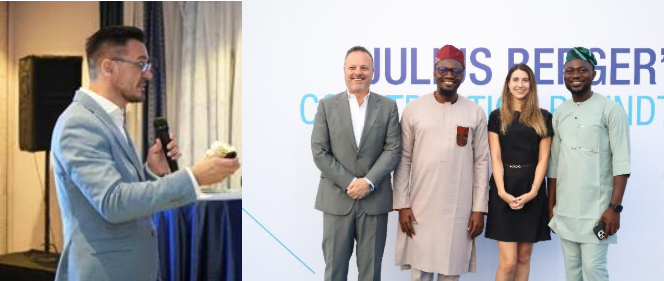
Addressing participants at the company’s one-day Construction Roundtable at its Excellence Centre in Abuja, Lubasch said Julius Berger approaches every project, whether a building, road, or bridge as a contribution to a shared national story of growth, connection, and durability.
He stated that the company’s guiding philosophy is rooted in the belief that construction must reflect societal responsibility, not merely technical precision.
Lubasch affirmed that in Nigeria’s building sector, Julius Berger continues to stand for structures of enduring quality.
Responding to widespread assumptions about the cost of premium construction, he explained that while initial capital investment may appear high, the long-term operational savings, energy efficiency, and lifespan of Julius Berger’s projects deliver exceptional value.
“The cost of design and construction is only the beginning,” Lubasch said. “What truly matters is how efficiently a building performs, how little maintenance it requires, and how long it endures.
“That’s why our designs focus on energy efficiency, durability, and sustainability—delivering buildings that serve generations, not just decades.”
He emphasised that the company’s commitment to quality is evident in its use of high-grade materials and adherence to global standards, ensuring that every structure can withstand the test of time.
“Our roads and bridges have become the arteries of Nigerian cities,” Lubasch noted, stressing that Julius Berger’s hallmark remains uncompromised quality and engineering integrity.
Lubasch reiterated that the company’s presence extends far beyond construction delivery to leadership in innovation. Citing recent developments in building technology, he disclosed that Julius Berger’s subsidiary, Abumet, introduced insulated glazing and Evonig glass to Nigeria’s architectural landscape.
He also referenced the company’s successful installation of Nigeria’s first fully prefabricated unitised curtain wall system in Lagos–manufactured locally, a milestone that he said underscores Julius Berger’s commitment to innovation and local content advancement.
On road construction, the Managing Director highlighted the introduction of cold recycling technology, describing it as an environmentally responsible and cost-effective method for road rehabilitation.
The process, he explained, aligns with international engineering standards such as those of the American Association of State Highway and Transportation Officials (AASHTO) and is designed for defined service lifetimes, varied soil conditions, and calculated axle loads.
“These innovations move the industry forward,” Lubasch said. “They prove that private ambition, guided by public vision, can deliver real, lasting impact.”
He urged participants to reflect on critical questions shaping the future of construction in Nigeria: how to build for sustainability, how to ensure today’s investments anticipate tomorrow’s needs, and how to create cities that reflect shared values as much as technical excellence.
Lubasch called for a collective commitment among engineers, developers, and policymakers to build cities that “serve people” and embody both private ambition and public purpose.
“Together, we can build not only the cities we want, but the cities future generations deserve—durable, sustainable, and full of promise,” he said.
In his presentation titled The City We Build: Private Ambition, Public Vision, Julius Berger’s Regional Manager for Region Central and North, Engr. Oliver Berger, examined pathways to a balanced and resilient Abuja.
He identified key drivers of the capital’s-built environment as developers, regulators, professionals, and the general public. Developers, he said, propel investment and private ambition, while public authorities regulate and set standards.
Oliver Berger observed that Abuja’s urban development faces a high concentration of estates in certain zones, limited emphasis on energy efficiency, and insufficient focus on green building practices.
Drawing parallels from Singapore’s landscaped housing estates, he stressed the need for capacity building and knowledge transfer to strengthen Nigeria’s built environment.
He noted that Abuja continues to face a severe housing deficit as supply fails to meet demand. High land and bureaucratic costs, he explained, have driven property prices beyond the reach of average income earners, while access to affordable mortgage options and rent-to-own schemes remains limited.
“The market is skewed towards high-end developments,” he stated. “This creates a shortage of affordable housing, weakens inclusivity, and undermines sustainability.”
Oliver Berger identified additional challenges such as inconsistent policy enforcement, insecurity that discourages investment, infrastructural gaps in emerging districts, and a persistent mismatch between supply and demand.

To address these concerns, he recommended a framework for action that integrates durability, affordability, and innovation.
He called on stakeholders to promote resilient housing through the use of climate-resistant materials, structurally sound foundations, and adaptable designs suited to local environmental conditions.
He also advocated for affordable housing models tailored to different income levels, functional yet aesthetic architectural designs, flexible financing mechanisms–including rent-to-own, cooperative schemes, and mortgage plans–and mixed-use developments that blend residential and commercial utility.
The Regional Manager further urged the adoption of smart urban planning anchored on efficient road networks, integrated public corridors, and the inclusion of green spaces, parks, and recreational zones.
He underlined the need for pedestrian-friendly designs that promote accessibility and sustainability, aligning Abuja’s development with global benchmarks for smart cities.
Oliver Berger maintained that dialogue and collaboration between public and private sectors are essential to create balanced urban growth.
“We must incentivise sustainable, future-fit designs, enforce building standards with accountability, and promote innovative financing for green and smart developments,” he stated.
He stressed the importance of continuous capacity building for professionals and regulators, noting that improved expertise within the industry would enhance compliance and efficiency.
The Construction Roundtable, according to participants, served as an important platform for dialogue on the evolution of Nigeria’s construction industry and urban future. Attendees commended Julius Berger for convening the session and reaffirmed the value of knowledge exchange in shaping sustainable national development.
The event was attended by representatives of the Federal Capital Territory (FCT) Minister, the Executive Secretary of the FCT Administration, industry executives, and senior management staff of the Julius Berger Group.