By Ofem John, JkNewsMedia Intern, Cross River State
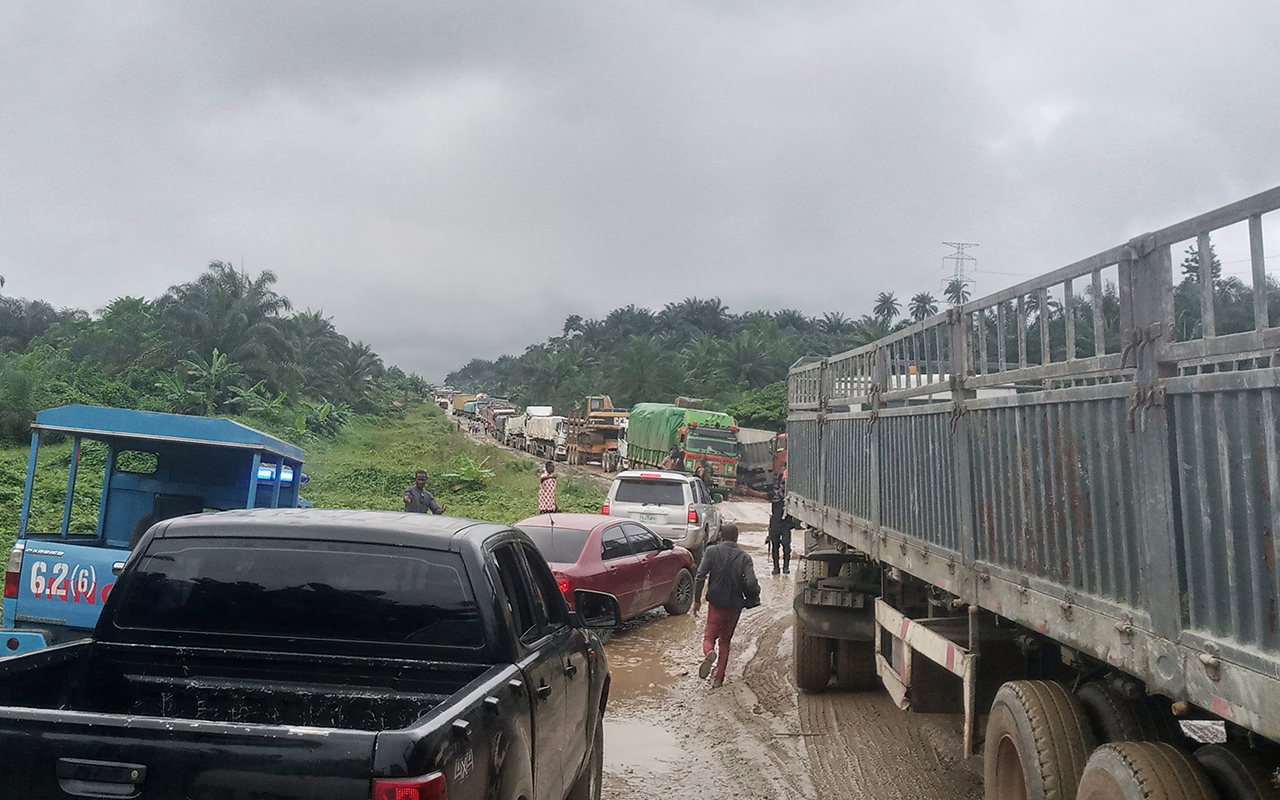
TRAFFIC REMAINED paralysed for days along the Calabar–Itu Highway after large sections of the road caved in, leaving thousands of commuters and truck drivers stranded between Akwa Ibom and Cross River States.
The once-busy route linking the South-South and South-East regions has turned into a scene of chaos, with vehicles stuck for hours in an endless gridlock.
Travellers recounted harrowing experiences of fatigue, loss of income, and sleepless nights on the road.
Many described how what was once a routine two-hour journey has become an ordeal lasting more than twelve hours due to the deteriorating condition of the highway.
“A two-hour trip now takes over twelve hours. Trucks are stuck, and people sleep on the road,” said Uwem Isaiah, a commuter who had been trapped for two days near the collapsed section.
Another traveler, Eka Success, said passengers were forced to spend the night inside their vehicles as movement became impossible.
“We couldn’t find any nearby accommodation or even food. Everyone was stranded. Some slept in buses, others under trucks,” she said.
Commercial transporters and haulage operators also said the bad road has paralysed business activities and caused a sharp rise in operational costs.
Furthermore, bus and truck drivers lamented the daily losses incurred due to fuel consumption, vehicle breakdowns, and delays in delivery schedules.
“We can’t make more than one trip a day. We’re suffering,” said Akpan, a commercial driver operating along the route. “The road is gone. Tyres get damaged every day, and engines overheat because of the long hold-up. We’re spending more than we earn.”
The highway, which generally serves as a vital economic corridor connecting Akwa Ibom, Cross River, and neighbouring states, has been a recurring subject of public concern over the years.
Residents say its failure has disrupted not only passenger movement but also the transportation of goods, including petroleum products, building materials, and agricultural produce.
Also, local traders in Itu and Odukpani have also expressed frustration, saying the road collapse has affected the supply of essential goods and driven up market prices.
Despite the severity of the situation, road users say no visible progress has been made to address the problem.
This comes even after recent visits by members of the National Assembly Joint Committee on Works, who toured the affected stretch as part of an oversight inspection.
While the lawmakers had reportedly assured the public of government attention to the road, commuters insist that conditions have worsened since then.
“The committee came, they saw it, they took pictures and left. But nothing has changed,” said a truck driver, who identified himself as Effiong.
“We have been here for three days now. Some trucks have broken down. There’s no water, no food, and no security at night. People are getting frustrated.”
Local residents who depend on the highway for daily activities also shared their concerns. Farmers in communities near the collapsed portions said transporting produce to markets in Calabar and Uyo has become nearly impossible.
“We used to go to Uyo every market day, but now we can’t cross the bad spot. The cost of transport has tripled,” said one resident of Obot Itu.
Transport unions and logistics operators have called for immediate intervention, warning that the prolonged collapse could have severe economic consequences for the region.
The Calabar–Itu route remains one of the few direct links between the industrial zones of Akwa Ibom and the Cross River corridor, and its obstruction poses a major setback to regional trade and mobility.
Road users and community leaders are appealing to the Federal Ministry of Works to deploy emergency measures to stabilise the road while long-term reconstruction continues.
“We need urgent repair to open the road. Even if they start full reconstruction later, let there be a temporary solution now,” said one commercial bus operator. “People are stranded every day, and goods are wasting on the road.”
Observers note that the Federal Government had earlier awarded sections of the Calabar–Itu–Ikot Ekpene Highway to different contractors under the Ministry of Works and Housing as part of ongoing efforts to rehabilitate critical infrastructure in the South-South.
However, commuters said they have yet to see any major progress since the announcement.
The current gridlock has also raised safety concerns.
Travelers report that the standstill has exposed them to risks of robbery and health complications from dehydration and stress.
Many have called on security agencies to increase patrols along the blocked sections to ensure protection for stranded motorists.
The Calabar–Itu Highway, originally constructed in the 1970s, has undergone only limited maintenance over the decades despite being one of the busiest routes in the region.
Heavy-duty trucks and poor drainage have accelerated its deterioration, causing repeated washouts and gully erosion along several points.
Local authorities say that without urgent stabilisation and reconstruction, the road may become completely impassable.
As of Thursday, several trucks carrying goods and fuel tankers remained stuck on both sides of the collapsed portions, while long queues of vehicles stretched for kilometres.
Travelers expressed disappointment over the slow response to what they described as a humanitarian and economic emergency.
“The suffering here is too much. Some people have been here for days without food or rest. We need help,” said a passenger heading to Calabar.
Commuters are now urging the Federal Government to intervene swiftly by deploying emergency teams to the affected areas to restore movement and prevent further hardship.
They also want the Federal Ministry of Works to ensure strict supervision of contractors handling the project to guarantee timely and durable reconstruction.